
Emergency Air Duct Cleaning Near Me: What Northgate Homeowners Should Do First
If you’ve just found a dead animal in your ductwork, or smoke from a nearby fire is being pulled into your HVAC returns, the worst move is to keep the system running while you wait for someone to arrive. Shut the thermostat to OFF first. Then protect the rest of the house. Most duct “emergencies” turn out to be urgent-but-manageable situations that need careful triage, not a panicked scramble for the nearest coupon. Getting the first thirty minutes right is what separates a contained problem from one that spreads through every branch of the system in your Northgate home.
Key Takeaways
- Turn the HVAC system off before you call anyone. Running it spreads contamination through the whole duct network.
- A true emergency usually means fire/smoke residue, confirmed water saturation, rodent or animal intrusion, or visible mold growth. A musty smell is urgent, not an emergency.
- Every real emergency starts with a visual inspection and camera scope, never with suction.
- Document everything with photos. It helps with insurance and gives your technician a baseline.
- Contamination rarely stops at the duct walls. If the system was flooded or smoke-damaged, the air handler and coil need a look too.
What Actually Counts as a Duct Emergency in Northgate?
A duct emergency is any situation where contamination is actively getting worse or poses a safety risk right now: fire or smoke residue being drawn into the returns, standing water or saturation inside the ductwork, a dead animal or rodent activity, or visible mold growth around vents and registers. A persistent musty odor or worsening allergy symptoms with no obvious source is urgent but usually not an emergency, and can be scheduled for prompt inspection. In Northgate, the most common call we get is one of the first two: smoke from a kitchen or structure fire nearby, or a leak that soaked insulation and duct interiors before anyone noticed.
Here’s how to sort your situation quickly:
- Fire or smoke contamination: treat as an emergency. Soot and ash pull straight through the return side.
- Confirmed water saturation in ducts or insulation: emergency. Wet duct interiors are where mold gets its start.
- Rodent or animal intrusion: emergency if the animal is still present, urgent if it’s a carcass and droppings.
- Visible mold on registers or inside supply boots: urgent to emergency, depending on how much you can see.
- Musty smell, uneven airflow, worsening allergies: urgent. Book an inspection soon; you don’t need a middle-of-the-night call.
If you’re not sure which bucket you fall into, that’s fine. Describe what you’re seeing and hearing to a technician and let them triage with you.
The First-Response Checklist: What to Do Before Anyone Arrives
Your goal in the first thirty minutes is to stop the spread. Every step below is about containment, not cleaning. Don’t start pulling apart ductwork or vacuuming with a shop vac; that’s the fastest way to redistribute fine particulate into rooms that were clean a minute ago.
- Shut the system off at the thermostat. Set it to OFF, not just a lower temperature. Then flip the air handler breaker if you can safely reach it.
- Close windows and doors on the affected side of the house so airborne contaminants aren’t pulled through living spaces by stack effect.
- Seal visible returns with plastic sheeting and painter’s tape if you can see contamination around the grille. Don’t seal so tightly that you trap moisture; this is about particles, not airtight containment.
- Keep people and pets out of the affected rooms. Anyone with asthma or respiratory sensitivity should stay clear.
- Photograph everything before you touch anything else: registers, the visible duct interior, the air handler, any water staining. Save the photos; insurance adjusters love a clean chronological record, and your technician gets a head start on scope.
- Call a duct cleaning company that can actually handle contamination-level work. Ask specifically whether they use negative-air equipment and HEPA filtration. A shop that only offers rotary brushing and a shop vac isn’t equipped for a true emergency.
One thing worth a small smile: if your first instinct was to grab the household vacuum, you’re in good company. It’s the wrong tool here, but the instinct to do something is exactly right.
Why Inspection Comes Before Cleaning in a Real Emergency
In a genuine emergency, the single most important step happens before any cleaning head touches the inside of a duct: inspection. A technician should walk the system – every accessible register, the return plenum, the air handler cabinet – and run a camera scope through the main trunk lines. This does two things. First, it locates the source, which is often not where you think it is. A dead animal smell near one vent can originate thirty feet away in a branch line. Second, it tells the technician what kind of contamination they’re dealing with and where the boundaries are.
Skipping inspection and going straight to suction is the classic mistake of a blow-and-go operation. Here’s what goes wrong: suction without containment creates negative pressure but not directional control. Fine particulate, mold spores, and rodent debris get stirred into the airstream and pushed into branches that were clean. What should have been a single-room problem becomes a whole-house job.
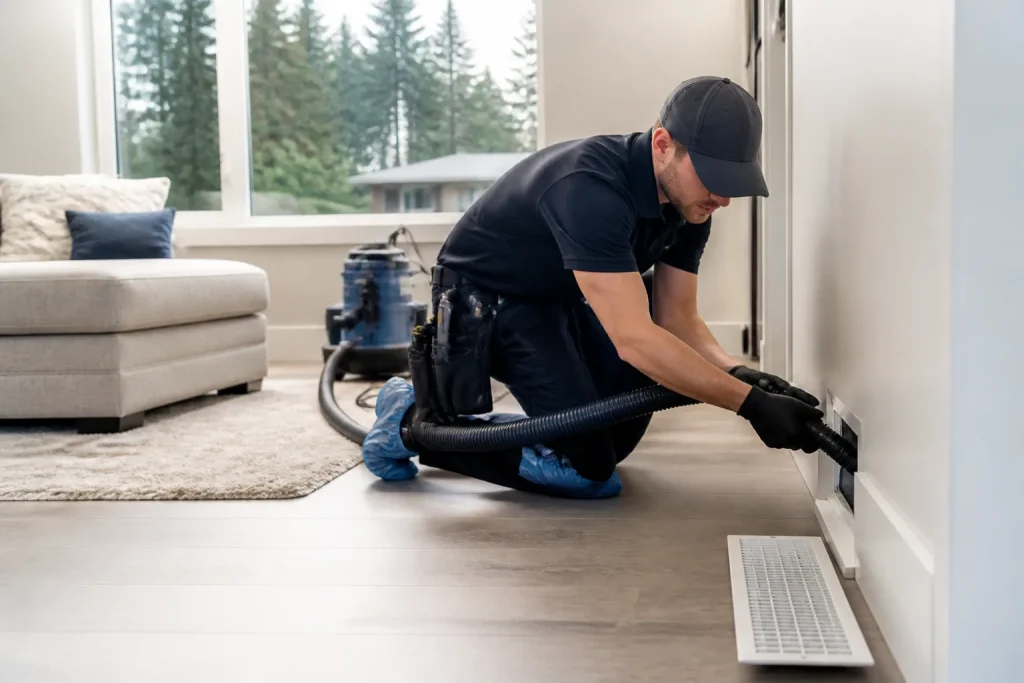
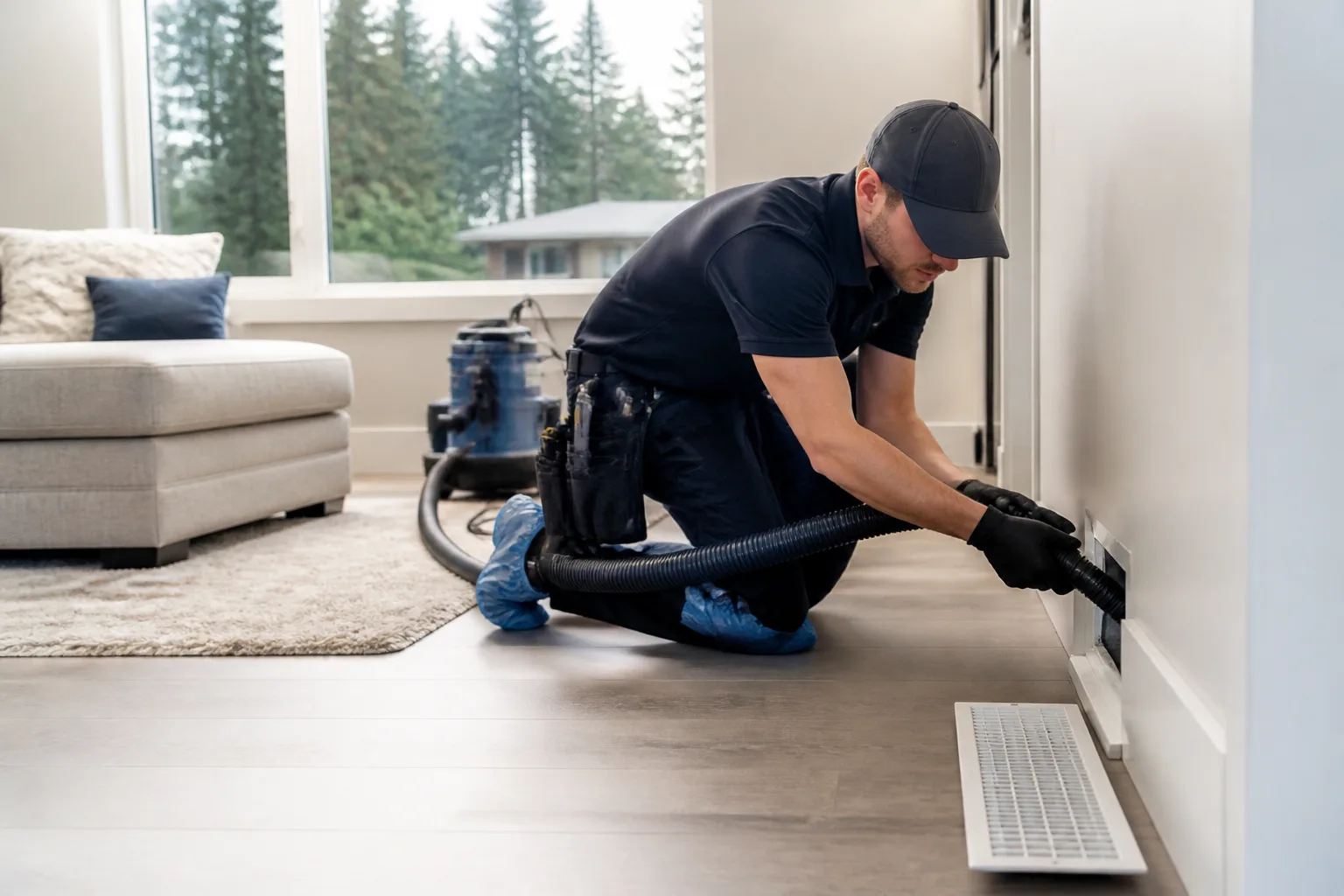
The professional standard is a dual-method approach. Mechanical agitation from a Rotobrush tool loosens contamination from the duct walls, and negative-air extraction from Nikro or Abatement Technologies equipment pulls it out of the system under controlled pressure. That combination is what makes the difference between removing contamination and redistributing it. For a standard clean, that matters. In a fire or flood scenario, it’s the whole ballgame.
What Same-Day Emergency Service Actually Covers
Same-day emergency duct work typically covers two things: stabilization and the main cleaning pass. Stabilization means the system is off, the source is identified, loose contamination has been extracted under negative air, and the immediate risk (smoke odor, animal debris, saturated insulation) is contained. The main cleaning pass removes the bulk of the contamination from accessible ductwork, registers, and the air handler.
What usually requires a follow-up visit:
- Sanitization cure time. If the job calls for an antimicrobial or sanitizing treatment after cleaning, that product needs time to work and dry before the system goes back into service. It’s not something you come back from on the same visit.
- Duct repair and sealing. Contamination often finds the leaks and gaps first. Closing those gaps is a separate stage and shouldn’t happen while the ducts are still wet or contaminated.
- Air quality equipment assessment. If contamination is a recurring issue, whole-home filtration or humidity control may be worth discussing. That’s a planning conversation, not a same-visit add-on.
- HVAC unit inspection and repair. More on this below.
A duct cleaning team that offers duct repair and sealing in-house saves you from trying to schedule a second contractor after the cleaning is done. One visit for the whole system is the goal, but real emergencies sometimes need a sequenced approach – and an honest company will tell you which parts wait.
When the Ducts Aren’t the Whole Story: HVAC Inspection
Contamination rarely stops at the duct walls. In a smoke or fire situation, the air handler cabinet, blower wheel, and evaporator coil are in the path of everything that moved through the returns. In a water intrusion, the same components get wet and stay wet. That means any real emergency response includes an HVAC inspection, not just duct cleaning. A technician should open the air handler cabinet and check the blower and coil for soot, moisture, and biological growth.
This is also where brand familiarity earns its keep. A crew familiar with Honeywell and Aprilaire controls can read your system’s setup and recommend whether whole-home filtration or humidity control makes sense after the problem is fixed. A crew familiar with Guardsman filters can advise you on which filtration upgrade actually fits your equipment. If the technician on-site can’t tell you the state of your blower and coil, that’s a sign the job was scoped too narrowly. Duct cleaning and hvac cleaning belong in the same conversation.
When to Call a Pro
Call a professional the moment you suspect any of the emergency categories above, and call the same day if a smell or symptom has been lingering for more than a week. You can handle the thermostat, the plastic sheeting, and the photos. The moment duct interiors are involved, you need negative-air equipment and someone who knows how to use it. DIY duct work in a contamination situation is a good way to spend more money later, not less. If you’re in Northgate and want an honest read on whether your situation is a true emergency or a scheduled job, that’s a free conversation.
Related services in Northgate: air duct cleaning for full-system cleans and inspections, dryer vent cleaning for lint buildup and safety checks, and the full breadth of what we do on our Air Duct Cleaning Northgate page.
Professional-grade equipment, not DIY tools. We use Rotobrush, Nikro, Abatement Technologies, Honeywell, Aprilaire, and Guardsman systems because emergency duct work rewards precision. Our technicians have up to 9 years of experience. The local professionals we connect Northgate homeowners with are licensed and insured as their state requires. Estimates are free, and the written estimate sets the final price. Call (877) 492-3448. We answer 24/7. Fast dispatch from 7am to 7pm, Sunday through Friday.
The Bottom Line
Sort the situation before you call: is it fire, water, or animal contamination (emergency), or a smell or symptom with no obvious source (urgent)? Turn the system off, contain what you can see, photograph everything, then call. Whether it’s fire residue or a persistent allergy smell, the process stays the same. Shut it down, scope it out, then clean with controlled negative air – not before. And one detail worth repeating from our own work in Northgate: smoke contamination is more common than you’d expect, so keep the thermostat off until the source is confirmed.
If you’re in Northgate and need help, Air Duct Cleaning Northgate offers free estimates. Call (877) 492-3448.
Frequently Asked Questions
First, turn the HVAC system off at the thermostat and flip the air handler breaker if you can safely reach it. Second, close windows and doors on the affected side of the house. Third, photograph any visible soot or staining at registers before you touch anything. Then call a duct cleaning company that uses negative-air extraction, because smoke residue spreads easily if the system runs before it’s cleaned.
Usually not, but treat it as urgent. A musty smell can mean mold growth somewhere in the system, but without visible mold or confirmed water saturation it’s a scheduled inspection, not a panic call. Book a camera-scope inspection soon so you know what you’re dealing with. Either way, keep the system off if the smell intensifies when the fan runs.
It can wait overnight if the system stays off, but don’t wait longer than that. Odor compounds and bacteria spread through the duct network the longer the animal remains inside. Keep people with respiratory sensitivity out of the affected rooms. Call for same-day or next-working-day service, and mention that it’s an animal intrusion when you book.
Partial, at best. Duct cleaning removes residue and odor source from the duct system, but soot and odor compounds often settle on surfaces, textiles, and contents too. A cleaning visit addresses the HVAC side. Once the ducts are clean and sealed, a separate step like surface cleaning or an air purifier may be worth discussing. If the ducts are the source, they’ll keep recontaminating the house until they’re clean.
Written by the team at Air Duct Cleaning Northgate.
Need Air Duct Cleaning Help?
Call Air Duct Cleaning Northgate - the local pro we connect you with is licensed and insured, here with fast help in Northgate.
(877) 492-3448